
 EN
 AR
 CS
 DA
 NL
 FI
 FR
 DE
 IT
 JA
 KO
 NO
 PL
 PT
 RO
 RU
 ES
 SV
 TL
 ID
 SK
 UK
 VI
 ET
 HU
 TH
 TR
 AF
 GA
 XH

PMSM Solutions for Singapore Industries: Applications and Project Selection Guide
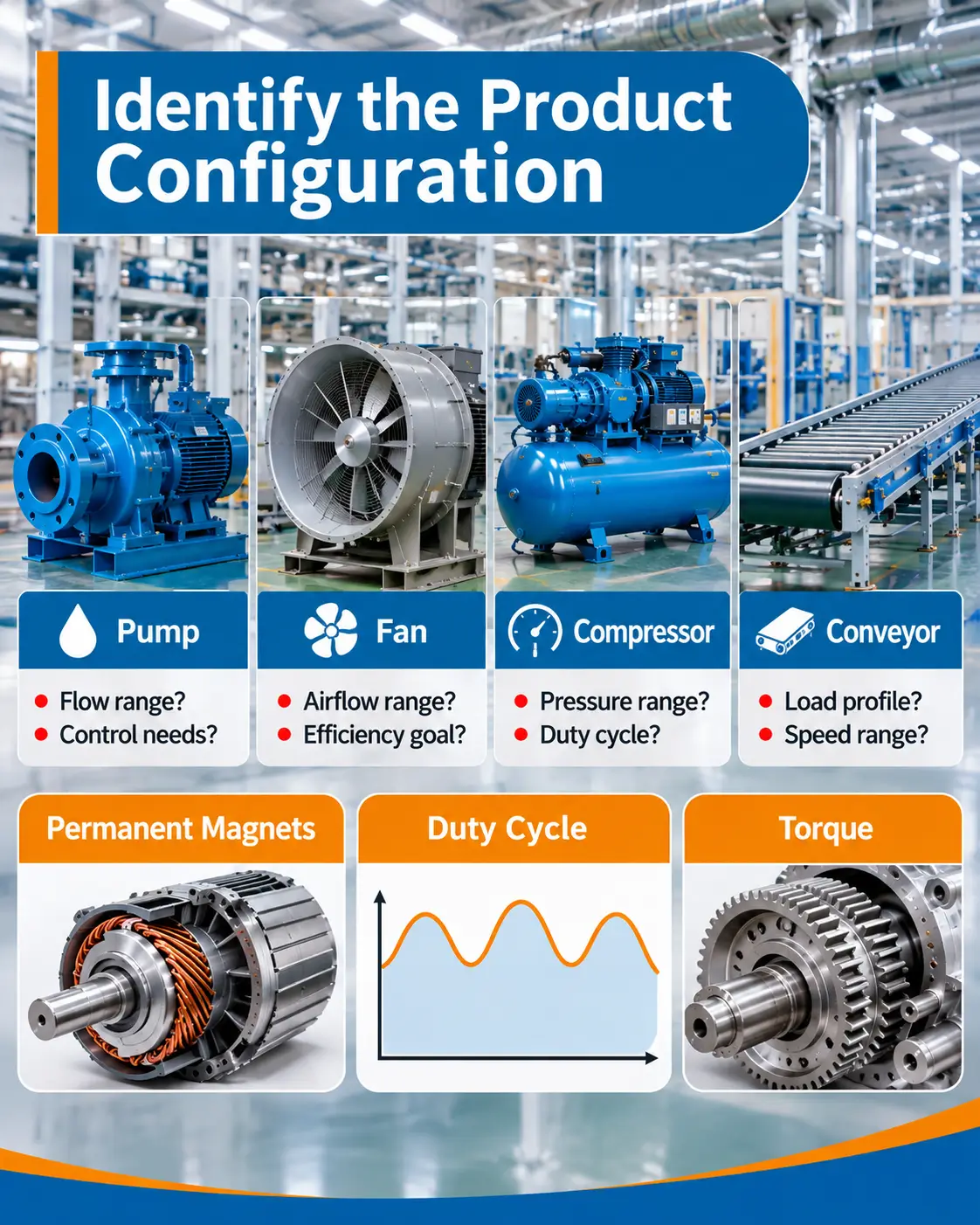
Industrial facilities in Singapore use electric motors across pumps, fans, compressors, conveyors and automated production equipment. However, selecting a Permanent Magnet Synchronous Motor (PMSM) based on industry type or rated power alone can lead to incorrect sizing, drive compatibility issues and unexpected integration costs. The right solution depends on how the equipment operates, including its torque requirements, speed range, duty cycle, cooling conditions and control strategy. This guide examines where PMSM systems may fit across Singapore's industrial applications, how they compare with conventional motor solutions, and which technical requirements buyers should confirm before moving forward with a project.
1. Which Singapore Industrial Applications Are Suitable for PMSM Solutions?
PMSM systems can be considered for industrial applications that require efficient motor operation, variable-speed control, precise torque delivery or compact drive configurations. Relevant applications in Singapore include pumps, fans, compressors, conveyors and automated production equipment across semiconductor, precision engineering, chemical and biomedical manufacturing. However, suitability depends on the actual load profile, operating hours, control requirements and installation conditions, not simply the industry in which the equipment operates.
1.1 Where Can PMSM Systems Be Applied in Singapore's Manufacturing Sector?
Different manufacturing industries have different motor operating requirements. Therefore, PMSM selection should begin with the equipment being driven rather than the industry name.
Several industrial applications are worth evaluating.
Semiconductor and Electronics Manufacturing
Semiconductor and electronics facilities use motor-driven equipment in ventilation, cleanroom HVAC systems, process pumps and automated production machinery.
PMSM systems may be worth evaluating when applications require:
- Stable operation over extended operating periods.
- Variable-speed control to match changing process requirements.
- Consistent torque delivery.
- Efficient operation under defined load conditions.
- Integration with automated control systems.
For cleanroom-related equipment, motor selection must also consider installation location, airflow requirements, contamination control and maintenance accessibility. The motor itself is only one part of the complete equipment system.
Precision Engineering
Precision engineering facilities use motors in automated machinery, production equipment, auxiliary drive systems and selected machine-tool applications.
PMSM systems may be suitable when the equipment requires a defined speed range, controlled acceleration or consistent torque output.
However, applications involving precise positioning or spindle performance also require evaluation of the complete servo or drive system. A PMSM alone does not guarantee positioning accuracy.
Chemical and Process Industries
Process pumps, ventilation fans and selected compressor systems can operate for extended periods under changing load conditions.
For these applications, buyers should examine:
- Continuous operating requirements.
- Actual flow and pressure demands.
- Torque requirements across the operating range.
- Cooling and ambient conditions.
- Corrosion and hazardous-area requirements.
Environmental protection and applicable hazardous-area requirements must be confirmed according to the installation location.
Biomedical Manufacturing
Biomedical manufacturing facilities use motor-driven systems in production automation, pumps, ventilation and supporting utility equipment.
PMSM evaluation may be relevant where operating stability, speed regulation and equipment integration are important.
The final configuration should account for process requirements, cleaning conditions where applicable, operating schedules and equipment reliability expectations.
Food and Beverage Manufacturing
Pumps, mixers, conveyors and packaging machinery can involve different combinations of continuous operation, variable loads and frequent starting or stopping.
For these applications, buyers should consider torque requirements, acceleration characteristics, speed regulation and environmental protection.
Where equipment is exposed to washdown procedures, enclosure protection and installation design require particular attention.
1.2 When Does a Pump, Fan or Compressor Application Justify PMSM Evaluation?
Pumps, fans and compressors are important candidates for motor-system evaluation because their operating requirements can vary significantly.
However, not every pump, fan or compressor needs a PMSM.
Consider a pump operating at a relatively stable flow requirement. If its existing motor already operates efficiently and the system has limited opportunities for speed adjustment, replacing it with a PMSM may not produce sufficient economic benefits.
The situation changes when the equipment operates under varying demand.
For example, a process pump may need to deliver different flow rates throughout the production cycle. If the existing system relies on throttling to control flow, evaluating a variable-speed motor and drive system may be worthwhile.
Similarly, ventilation fans operating under changing airflow requirements may benefit from speed control when the operating profile supports it.
Buyers should investigate three questions:
- Does the equipment operate at varying load or speed requirements?
- Does the existing motor system consume unnecessary energy under actual operating conditions?
- Can a PMSM and compatible inverter improve overall system performance enough to justify the investment?
The same evaluation applies to compressors, although their load characteristics and control requirements must be assessed according to the compressor design.
The objective is not simply to replace an existing motor. It is to determine whether the proposed motor-drive system better matches the equipment's operating requirements.
1.3 Which Applications Require More Detailed Engineering Assessment?
Some industrial applications require more detailed evaluation before a PMSM configuration can be selected.
High starting torque applications
Equipment with high breakaway torque or demanding acceleration requirements needs an appropriate motor and drive combination.
The selected system must deliver the required torque during starting and acceleration without exceeding its electrical or thermal limits.
Frequent acceleration and deceleration
Automated production machinery and certain conveyor systems may experience frequent changes in speed.
These applications require evaluation of peak torque, acceleration time, braking requirements and the thermal impact of repeated operating cycles.
High continuous load applications
Equipment operating continuously under substantial load requires careful assessment of thermal performance.
The motor must maintain the required continuous torque under the specified cooling and ambient conditions.
Restricted installation environments
Limited ventilation, high ambient temperatures, humidity, dust or corrosive exposure can affect motor configuration and service life.
These conditions should be included in the technical specification rather than addressed after installation.
The key principle is straightforward: an application should only be considered suitable after its operating requirements have been translated into measurable motor and drive specifications.
2. What Technical Requirements Determine the Right PMSM Configuration?
A suitable PMSM configuration must be defined by the equipment's actual torque-speed requirements, duty cycle, operating hours, cooling conditions and drive compatibility. Rated power alone cannot establish whether a motor can deliver the required performance throughout the operating range. Buyers should evaluate continuous and peak torque, speed limits, acceleration demands, thermal capacity and installation constraints together before selecting a motor.
2.1 How Do Torque and Speed Requirements Affect PMSM Selection?
Rated power is an important starting point, but it does not describe the complete operating requirements of an industrial motor.
Torque and speed must be evaluated together.
For a rotating motor, mechanical output power is related to torque and rotational speed:
P = T × ω
Where:
- P is mechanical output power.
- T is torque.
- ω is angular speed.
This relationship explains why two PMSMs with the same rated power can have different torque and speed characteristics.
For example, a low-speed direct-drive application may require relatively high torque without operating at high rotational speed. Another application may require a higher speed range with a different torque profile.
Both applications may have similar rated power requirements, but their motor designs and drive configurations can be very different.
Before selecting a PMSM, buyers should confirm:
- Rated torque.
- Continuous torque.
- Peak torque and its required duration.
- Rated speed.
- Minimum and maximum operating speed.
- Acceleration and deceleration requirements.
- Required torque throughout the operating range.
A torque-speed curve is particularly useful because it shows how much torque the motor can deliver at different speeds.
It also helps identify operating regions where torque may be limited by voltage, current or thermal constraints.
The practical rule is to select a motor based on the required operating envelope, not simply its rated kW.
2.2 How Do Duty Cycle and Operating Hours Change Motor Requirements?
Duty cycle describes how a motor operates over time.
Two machines with identical rated power and torque requirements may need different motor configurations if their operating patterns are different.
Consider three typical operating conditions.
Continuous Operation
A pump or ventilation fan may operate for extended periods with relatively stable loading.
The motor must maintain its required continuous output without exceeding thermal limits.
Intermittent Operation
Some production equipment operates in repeated cycles, with periods of operation followed by rest.
The motor's thermal response depends on the operating and resting periods, as well as the load during each cycle.
Variable Load and Frequent Start-Stop Operation
Automated machinery, conveyors and certain process systems may experience changing torque requirements and repeated acceleration.
These applications require evaluation of peak torque, acceleration demands and accumulated heat.
Buyers should provide the following information:
- Operating hours per day.
- Operating hours per year.
- Continuous or intermittent operation.
- Number and frequency of starts.
- Load variation during operation.
- Duration of peak loading.
- Required acceleration and stopping times.
Operating hours also influence project economics.
A motor operating for extended periods may offer more opportunities for energy savings than equipment used occasionally. However, actual savings depend on the load profile and the efficiency of the complete motor-drive system.
2.3 How Do Cooling Conditions and Ambient Temperature Affect Continuous Performance?
Cooling conditions directly influence the continuous output capability of a PMSM.
Electrical losses generate heat inside the motor. This heat must be transferred through the motor's thermal path and released to the surrounding environment or cooling system.
Common cooling arrangements include:
Natural Cooling
Heat is dissipated through the motor housing and surrounding air without relying on an additional forced-air cooling system.
This arrangement can simplify system design, but its effectiveness depends on motor construction, installation and available heat dissipation.
Forced-Air Cooling
A fan increases airflow over the motor or through designated cooling passages.
This can improve heat removal, although the additional cooling equipment introduces its own power consumption, maintenance and installation considerations.
Liquid Cooling
Liquid cooling can provide a more controlled heat-removal arrangement in applications where thermal requirements or installation constraints justify it.
However, the system requires additional components, cooling infrastructure and maintenance considerations.
For industrial projects in Singapore, ambient conditions deserve particular attention.
A motor installed in a poorly ventilated equipment enclosure may experience different thermal conditions from an identical motor installed in an open, well-ventilated environment.
Buyers should distinguish between:
- Ambient temperature.
- Winding temperature.
- Magnet temperature.
- Internal motor temperature.
- Cooling medium temperature.
These values are related but are not interchangeable.
The actual thermal performance should be evaluated under the expected operating load and installation conditions.
A motor's continuous torque rating should therefore be confirmed together with its cooling configuration and thermal limits.
2.4 What Must Be Confirmed Between the PMSM and Its Drive System?
A PMSM and its inverter should be evaluated as one integrated drive system.
Selecting a motor first and assuming that any available inverter will operate it correctly can create commissioning and performance problems.
Several technical parameters need to match.
Electrical Compatibility
Confirm:
- Rated voltage.
- Rated current.
- Peak current requirements.
- DC bus voltage requirements.
- Electrical frequency and operating speed range.
The inverter must provide sufficient current and voltage for the required operating conditions.
Control Compatibility
PMSM systems may use different control approaches, including field-oriented control.
The selected inverter must support the motor's electrical characteristics and required control method.
Feedback Requirements
Some applications require encoder or resolver feedback for accurate speed or position control.
Others may support sensorless operation under suitable conditions.
The decision depends on speed range, dynamic performance and application requirements.
Acceleration and Braking
Frequent acceleration, deceleration and braking may affect inverter sizing and system configuration.
Regenerative braking requirements, where applicable, should also be evaluated.
Protection and Commissioning
Motor protection, temperature monitoring, parameter configuration and control interfaces should be confirmed before installation.
A complete compatibility review should include the motor datasheet, inverter specifications, control requirements and intended operating profile.
2.5 Which Installation and Environmental Conditions Affect the Final Configuration?
The electrical performance of a PMSM does not guarantee that it can be installed directly into an existing machine.
Mechanical and environmental requirements also influence the final configuration.
Buyers should confirm:
Mechanical Interface
- Mounting arrangement.
- Shaft diameter and length.
- Keyway or coupling requirements.
- Overall motor dimensions.
- Mounting position.
- Permissible mechanical loads.
Environmental Protection
- Required IP protection rating.
- Exposure to moisture or water.
- Dust and particulate exposure.
- Corrosion risks.
- Ambient temperature.
- Ventilation and cooling space.
Special Installation Requirements
Certain chemical, process and marine applications may require additional protection or certification.
Where hazardous areas are involved, the applicable equipment certification and installation requirements must be established before selecting the motor.
The most effective approach is to review the motor drawing, equipment interface and site conditions together before approving the final configuration.
3. Should You Choose PMSM or an Existing Induction Motor System?
A PMSM system is worth evaluating when the application benefits from high efficiency, variable-speed operation, torque control or compact motor design. An induction motor may remain the more practical choice when an existing system already meets its performance and energy requirements, replacement costs are high, or the application does not justify additional integration work. The decision should be based on operating conditions and total system performance rather than motor technology alone.
3.1 When Does PMSM Offer a Practical Advantage Over an Induction Motor?
PMSM systems use permanent magnets to establish the rotor magnetic field.
Unlike an induction motor, they do not require rotor current to produce that magnetic field through electromagnetic induction.
This design difference can reduce certain motor losses and support high-efficiency operation.
PMSM systems may be particularly worth evaluating when:
Energy Efficiency Is a Priority
Applications with substantial annual operating hours may offer opportunities to reduce electricity consumption if the proposed PMSM system operates more efficiently under the actual load profile.
Variable-Speed Operation Is Required
A PMSM combined with a suitable inverter can provide controlled speed operation across its designed operating range.
This is useful when equipment demand changes throughout the production process.
Torque Density and Installation Space Matter
Some PMSM designs can provide high torque density relative to their physical size.
This may be valuable in equipment with restricted installation space, although the final design must still meet thermal and mechanical requirements.
Specific Dynamic Performance Is Required
Applications involving controlled acceleration, deceleration or torque response may benefit from an appropriately configured PMSM drive system.
However, these advantages must be evaluated at the system level. Motor design, inverter capability, cooling and control configuration all affect actual performance.
3.2 When Is an Induction Motor with VFD Still the Better Option?
An induction motor combined with a variable frequency drive remains a practical solution for many industrial applications.
There are several situations where replacing an existing system with a PMSM may not be justified.
The Existing System Already Meets Its Requirements
If the motor operates efficiently, delivers the required torque and provides sufficient speed control, replacing it may produce limited additional value.
The Application Has Relatively Simple Operating Requirements
Some equipment operates at relatively stable speeds and loads.
If the existing system already meets these requirements, the benefits of a different motor technology may not justify the additional investment.
Integration Costs Are High
A PMSM retrofit may require a new inverter, control modifications, mechanical adaptation and additional commissioning work.
These costs should be included in the project evaluation.
Maintenance and Operational Familiarity Matter
An established induction motor system may already have a familiar maintenance process, available spare parts and proven operating procedures.
Changing the technology introduces new technical and operational considerations.
The correct decision is therefore not to replace every induction motor with a PMSM.
It is to identify applications where the proposed PMSM system provides a measurable improvement that justifies the project cost and implementation effort.
3.3 What Are the Engineering and Commercial Trade-offs?
PMSM and induction motor systems involve different engineering and commercial considerations.
| Decision Factor | PMSM System | Induction Motor + VFD |
|---|---|---|
| Motor efficiency | Can offer high efficiency, depending on design and operating point | Depends on motor efficiency and operating conditions |
| Part-load performance | Can provide advantages in suitable operating conditions | Depends on motor design and VFD configuration |
| Drive integration | Requires compatible PMSM control and configuration | Requires compatible induction motor control |
| Torque density | Often advantageous in compact designs | Depends on motor design |
| Initial investment | Must include motor, inverter and integration | Must include motor, VFD and integration |
| Maintenance | Depends on motor construction and system design | Established maintenance practices are widely used |
| Lifecycle cost | Must be calculated using project operating data | Must be calculated using project operating data |
The trade-off becomes clearer when considered in a real project.
Suppose a manufacturing facility wants to upgrade a pump system that operates for extended periods under changing flow requirements.
A PMSM system may offer improved operating efficiency and speed control.
However, the project may also require a new inverter, control-system integration and commissioning.
If the existing induction motor and VFD already perform well, the additional investment may not be economically attractive.
In contrast, if the existing system operates inefficiently under changing loads, a complete system evaluation may identify a stronger case for PMSM.
The buyer should compare both solutions using the same operating conditions and performance requirements.
3.4 When Does a PMSM Retrofit Make More Sense Than a New Motor System?
A PMSM retrofit can be attractive when existing equipment remains mechanically suitable but its motor-drive system needs improvement.
However, motor replacement is rarely a simple component exchange.
Before approving a retrofit, buyers should investigate:
- Can the proposed PMSM fit the existing mounting arrangement?
- Are the shaft and coupling dimensions compatible?
- Does the existing inverter support PMSM operation?
- Will the electrical supply and control interfaces require modification?
- Can the required torque and speed be achieved?
- Can the installation be completed within the available maintenance shutdown period?
A new PMSM system may be more appropriate when the existing equipment has significant mechanical limitations or when the project allows a complete redesign.
A retrofit may be more practical when the mechanical system is already suitable and the required motor-drive changes are manageable.
The decision should consider total integration cost, expected operating benefits and the consequences of equipment downtime.
4. How Do Initial Cost, Energy Consumption and Integration Affect PMSM Project Economics?
The economic case for a PMSM project depends on more than the motor purchase price. Buyers should compare the initial cost of the motor, inverter, control integration and installation with expected energy consumption, maintenance requirements and operating hours. PMSM becomes commercially attractive when measurable operating benefits justify the additional investment within the project's financial evaluation period.
4.1 What Costs Should Buyers Include Beyond the PMSM Purchase Price?
The purchase price is only one component of a complete PMSM project.
Buyers should evaluate the following costs.
Motor and Drive Equipment
- PMSM purchase price.
- Inverter or drive system.
- Feedback devices where required.
- Cooling equipment where applicable.
- Protection and monitoring components.
Mechanical Integration
- Mounting modifications.
- Shaft or coupling adaptation.
- Additional mechanical components.
- Equipment redesign where necessary.
Electrical and Control Integration
- Wiring and electrical modifications.
- Control-system configuration.
- Communication interfaces.
- Inverter parameter setup.
- Commissioning.
Project Validation
- Engineering review.
- Prototype testing.
- Thermal testing.
- Performance verification.
- Documentation.
Operational Considerations
- Spare parts.
- Maintenance requirements.
- Expected downtime.
- Technician training.
- Replacement planning.
For an existing industrial facility, downtime can be a particularly important project cost.
A motor replacement that requires extended production interruption may have a very different financial outcome from a replacement completed during a planned maintenance shutdown.
4.2 How Should Buyers Evaluate Potential Energy Savings?
Energy savings should be calculated using actual operating conditions rather than general efficiency claims.
A useful starting point is to compare the electrical energy consumed by the existing motor-drive system with the proposed PMSM system.
Annual energy consumption can be estimated using:
Annual Energy Consumption = Average Input Power × Annual Operating Hours
For example, consider a hypothetical application where the existing system has an average input power of 30 kW and operates for 6,000 hours annually.
Its estimated annual energy consumption would be:
30 kW × 6,000 hours = 180,000 kWh
This is an illustrative calculation, not an industry benchmark.
The proposed PMSM system must be evaluated under the same operating conditions.
Buyers should compare:
- Average input power.
- Operating load distribution.
- Motor efficiency at relevant operating points.
- Inverter losses.
- Auxiliary cooling power.
- Mechanical transmission losses where applicable.
The comparison should also consider whether the existing system uses throttling, bypass control or other methods that affect total system efficiency.
A motor with a higher rated efficiency does not automatically guarantee the same percentage improvement in overall equipment energy consumption.
4.3 When Can Higher Initial Investment Be Justified?
A higher initial investment may be justified when the expected operating benefits are sufficient to offset the additional project cost.
Three conditions are particularly important.
High Annual Operating Hours
Equipment operating for extended periods may provide more opportunities to recover an efficiency-related investment.
A Suitable Load Profile
The proposed PMSM system must provide benefits under the actual operating points, not just under its rated test conditions.
Manageable Integration Costs
The project must account for the complete motor-drive system and installation requirements.
A simple payback calculation can be used as an initial screening tool:
Payback Period = Additional Investment ÷ Annual Financial Savings
For a meaningful result, annual financial savings should account for energy cost differences and other measurable operating benefits.
A more complete lifecycle cost assessment may also include maintenance, downtime, replacement and financing considerations.
Buyers should use actual electricity tariffs, operating data and supplier quotations rather than generic payback assumptions.
4.4 Which Project Conditions Can Increase Integration Costs?
Several factors can increase the cost of implementing a PMSM solution.
Non-Standard Motor Dimensions
Custom mounting, shaft or housing requirements may require additional engineering and manufacturing work.
Control-System Modifications
An existing inverter may not support the proposed PMSM configuration.
Replacing the drive or modifying the control system can increase project costs.
Cooling Requirements
Applications with restricted ventilation or high thermal loads may require additional cooling provisions.
Environmental Protection
Special enclosure protection, corrosion resistance or application-specific certification may increase the total equipment cost.
Testing and Commissioning
Applications with demanding performance requirements may need additional validation before final approval.
These factors should be identified during technical evaluation rather than after a purchase order has been issued.
5. What Can Go Wrong in a PMSM Project and How Should the System Be Validated?
A PMSM project can fail to meet its expected performance when motor sizing, torque-speed requirements, thermal limits, inverter compatibility or installation conditions are incorrectly defined. Before approving production or a retrofit, buyers should review the complete operating specification, verify motor-drive compatibility and test the system under representative load conditions. Validation should confirm both continuous operation and required peak performance.
5.1 What Are the Most Common PMSM Selection and Integration Risks?
Several project risks can arise when the initial requirements are incomplete.
| Project Risk | Possible Cause | Potential Impact |
|---|---|---|
| Incorrect motor sizing | Selecting based only on rated power | Insufficient torque or unnecessary oversizing |
| Thermal problems | Cooling conditions not considered | Reduced continuous output or overheating |
| Drive incompatibility | Incorrect inverter selection | Unstable operation or commissioning problems |
| Poor operating performance | Incorrect torque-speed requirements | Equipment fails to meet operating demands |
| Mechanical rework | Mounting and shaft interfaces not confirmed | Installation delays and additional costs |
| Unrealistic energy savings | Estimates based on rated efficiency alone | Incorrect ROI calculations |
| Production inconsistency | Inadequate validation of the final configuration | Performance variation during deployment |
One of the most important risks is confusing peak performance with continuous capability.
A motor may deliver a specified peak torque for a limited duration but may not be able to maintain that torque continuously.
If the equipment requires sustained high torque, the selection must be based on the motor's continuous thermal capability.
Similarly, an inverter that can support the motor's rated power may still be unsuitable if its current capacity or control configuration cannot meet the application's peak requirements.
These issues should be identified before procurement approval.
5.2 What Information Must Be Reviewed Before Prototype or Retrofit Approval?
A structured engineering review helps identify missing information before the project moves into testing.
Motor Documentation
- Motor datasheet.
- Rated voltage and current.
- Rated speed and torque.
- Continuous and peak torque specifications.
- Torque-speed curve.
- Cooling arrangement.
- Temperature limitations.
Drive Documentation
- Inverter datasheet.
- Voltage and current ratings.
- Supported control methods.
- Feedback requirements.
- Protection functions.
- Motor parameter configuration.
Mechanical Documentation
- Motor outline drawing.
- Mounting dimensions.
- Shaft specifications.
- Coupling requirements.
- Installation space.
Application Documentation
- Equipment load profile.
- Duty cycle.
- Operating hours.
- Required acceleration.
- Operating environment.
- Expected performance.
The engineering review should identify which requirements are already confirmed and which still need testing.
A parameter that has not been verified should not be treated as an established design value.
5.3 How Should PMSM Performance Be Tested Under Actual Operating Conditions?
A PMSM system should be tested under conditions representative of its intended application.
Testing should cover three main areas.
1. Performance Testing
Verify:
- Rated speed.
- Required torque.
- Continuous operating torque.
- Peak torque capability.
- Speed regulation.
- Acceleration and deceleration response.
Testing should include the operating points that matter to the application.
For a variable-speed pump, for example, testing only at rated speed may not demonstrate how the system performs across the required flow range.
2. Thermal Testing
Verify:
- Winding temperature.
- Motor temperature rise.
- Cooling performance.
- Thermal stability.
- Operating temperature under representative load.
The test should reflect the specified cooling arrangement and relevant ambient conditions.
A motor should not be approved for continuous operation solely because it passes a short-duration load test.
3. System Integration Testing
Verify:
- Motor and inverter compatibility.
- Control response.
- Electrical performance.
- Mechanical vibration and noise.
- Protection functions.
- Communication and feedback signals where applicable.
The objective is to demonstrate that the motor-drive system performs as a complete unit.
5.4 What Are the Acceptance Criteria Before Moving to Production or Full Deployment?
Acceptance criteria should be defined before testing begins.
This avoids situations where the supplier and buyer interpret successful performance differently.
A practical acceptance framework includes:
| Validation Area | Acceptance Requirement |
|---|---|
| Torque | Meets agreed continuous and peak torque requirements |
| Speed | Covers the specified operating speed range |
| Thermal Performance | Remains within agreed temperature limits |
| Drive Compatibility | Operates correctly with the selected inverter |
| Mechanical Interface | Matches approved installation drawings |
| Electrical Performance | Meets specified voltage and current requirements |
| Operational Stability | Performs consistently under representative load conditions |
| Documentation | Required test records and technical documents are available |
For new equipment projects, successful engineering validation should precede pilot production.
For retrofit projects, representative load testing and commissioning should be completed before wider deployment.
For repeated production orders, the approved motor configuration and acceptance requirements should be maintained to support consistency.
The principle is simple: production approval should follow verified performance, not assumptions based on a datasheet alone.
6. How Should Buyers Select a PMSM Solution and Prepare the Next Project Step?
Buyers should select a PMSM solution by matching the motor configuration to the application's verified torque-speed profile, duty cycle, thermal requirements, drive system and installation constraints. A project should proceed only when its critical performance and integration requirements are confirmed. If essential information remains incomplete, the buyer should resolve those gaps before final specification approval, supplier commitment or full deployment.
6.1 What Information Should Buyers Prepare Before Requesting a PMSM Quotation?
A clear RFQ helps motor manufacturers evaluate the application and propose an appropriate configuration.
The following information should be prepared whenever available.
| Information | Required Details |
|---|---|
| Application | Pump, fan, compressor, conveyor or other equipment |
| Rated Power | kW or HP |
| Rated Torque | Nm |
| Peak Torque | Nm and required duration |
| Speed Range | Minimum, rated and maximum RPM |
| Duty Cycle | Continuous or intermittent |
| Operating Hours | Hours per day and year |
| Power Supply | Voltage and electrical requirements |
| Cooling | Natural, forced-air or liquid cooling |
| Installation | Mounting, shaft and dimensional requirements |
| Drive | Existing inverter or new drive requirement |
| Environment | Ambient conditions and protection requirements |
| Control | Speed regulation, feedback and communication requirements |
Not every project will have all these values available at the beginning.
For example, an equipment OEM may have a defined rated power but still need engineering support to establish the continuous torque requirement.
In this situation, the missing information should be identified as a specification gap rather than replaced with an unsupported assumption.
The more accurately the operating requirements are defined, the easier it becomes to evaluate motor configurations and compare supplier quotations.
6.2 What Should Buyers Evaluate When Comparing PMSM Suppliers?
Choosing a PMSM supplier involves more than comparing rated power and purchase price.
Buyers should assess whether the supplier can support the technical requirements of the project.
Application Understanding
Can the supplier understand the actual equipment, load characteristics and operating conditions?
Technical Specification
Can the supplier provide relevant motor performance data, including torque-speed characteristics, electrical ratings and thermal requirements?
Drive Compatibility
Can the supplier clarify inverter requirements and support motor-drive configuration?
Mechanical Integration
Can the supplier provide drawings and confirm mounting, shaft and dimensional requirements?
Validation Support
Can the proposed solution be evaluated against agreed performance and thermal acceptance criteria?
Production Consistency
Can the approved configuration and quality requirements be maintained across repeated orders?
A supplier that can clarify technical uncertainties early may help reduce specification changes, integration problems and project delays.
The objective is to identify a solution that meets the project's requirements, not simply the lowest initial quotation.
6.3 How Can Hiest Support PMSM Project Evaluation and Specification Confirmation?
For industrial buyers evaluating PMSM solutions, the first step should be to establish the actual equipment requirements before finalizing the motor configuration.
Hiest, associated with Hechuang Motor Technology Co., Ltd., focuses on industrial motor solutions, including Permanent Magnet Synchronous Motors.
In a PMSM project, the technical evaluation should begin with the application and its operating conditions.
The main areas to clarify include:
Application Requirement Review
Understand the driven equipment, load profile, operating speed and required torque.
Motor Specification Evaluation
Review rated power, continuous torque, peak torque, speed range and cooling requirements.
Drive Compatibility Review
Confirm the electrical and control requirements between the PMSM and its inverter.
Mechanical Specification Confirmation
Review mounting dimensions, shaft requirements and equipment interfaces.
Project Configuration Evaluation
Assess the proposed motor configuration against the intended application and installation conditions.
Prototype and Validation Planning
Establish which performance and thermal requirements need to be verified before wider project deployment.
For OEMs, equipment manufacturers and industrial buyers in Singapore, defining these requirements early provides a clearer basis for technical communication, quotation comparison and project planning.
The final configuration should always be determined by the confirmed project requirements and the engineering capabilities demonstrated by the proposed solution.
Quick Decision Guide: Which PMSM Direction Fits Your Project?
The following table provides a practical starting point for evaluating common industrial project conditions.
| Project Condition | Recommended Direction | Reason |
|---|---|---|
| High operating hours with measurable energy-saving potential | Evaluate PMSM | Potential lifecycle energy savings |
| Variable-speed operation with changing loads | Compare PMSM and induction motor with VFD | Actual operating efficiency matters |
| High continuous torque requirements | Conduct thermal and torque evaluation | Continuous output depends on thermal limits |
| Frequent acceleration and deceleration | Evaluate dynamic torque requirements | Peak torque and drive response matter |
| Limited installation space | Evaluate PMSM configuration | Torque density and dimensions may be relevant |
| Existing induction motor already performs efficiently | Retain existing system unless benefits are demonstrated | Avoid unnecessary retrofit costs |
| Existing motor requires replacement | Compare PMSM retrofit and conventional replacement | Consider compatibility and total project cost |
| Hazardous or corrosive installation environment | Verify environmental and certification requirements first | Equipment must meet site requirements |
| Incomplete load and operating data | Delay final specification approval | Prevent incorrect motor sizing |
Go, Conditional Go, or No-Go: Is Your PMSM Project Ready?
Before moving from technical evaluation to procurement, prototype development or wider deployment, buyers should assess whether the critical requirements have been confirmed.
GO
A project can proceed to the next stage when:
- Application and load profile are defined.
- Continuous and peak torque requirements are confirmed.
- Operating speed range is established.
- Cooling and thermal requirements are acceptable.
- Motor and inverter compatibility is verified.
- Mechanical and electrical interfaces are confirmed.
- Expected project economics meet the buyer's requirements.
Next stage: Technical specification approval or prototype development.
CONDITIONAL GO
A project can continue with engineering evaluation when some non-critical details remain unresolved, provided they have clear owners and deadlines.
Examples include:
- Peak torque duration requires further confirmation.
- Thermal performance needs additional testing.
- Existing inverter compatibility requires engineering review.
- Mechanical interfaces need modification.
- Lifecycle cost depends on operating data that is not yet available.
- Site-specific environmental requirements remain under review.
Next stage: Engineering review and prototype validation.
A Conditional Go should not be interpreted as approval for unrestricted mass production.
NO-GO
The proposed configuration should not proceed when:
- Required torque cannot be achieved within the operating range.
- Continuous thermal limits cannot be met.
- Motor and inverter compatibility cannot be established.
- Installation requirements cannot be satisfied.
- Mandatory application compliance requirements cannot be demonstrated.
- Essential project acceptance criteria remain unmet.
Next action: Revisit motor sizing, configuration, cooling design, drive selection or the alternative motor technology.
Conclusion
Selecting a PMSM for an industrial application in Singapore requires more than identifying the right motor power or choosing a technology with a high efficiency rating.
The most important decision is whether the complete motor-drive system can meet the equipment's actual operating requirements.
Buyers should prioritize five areas before approving a configuration: torque-speed profile, duty cycle, cooling conditions, inverter compatibility and lifecycle cost.
A PMSM should not move into production or wider deployment when its continuous performance, thermal limits or system integration requirements remain unverified.
For industrial OEMs, plant engineers and technical procurement teams, the most practical next step is to prepare an application-based motor specification covering the equipment load, operating conditions and required performance.
A clear specification creates a stronger foundation for supplier evaluation, accurate quotation, engineering validation and successful project execution.
The right PMSM solution is not simply the motor with the highest efficiency rating. It is the motor-drive system that meets the application's verified operating requirements, thermal limits and lifecycle cost expectations.